

🌻 Introducing Seed to Seed: The Bloom Bulletin Field Journal.
When most people think about our Sunflower Festival, they picture thousands of bright yellow blooms stretching across the field.
But every sunflower has a story, and it begins long before the first flower opens.

This year, we’re inviting you behind the scenes with Seed to Seed: our season-long journey following the life of our sunflower field. Through The Bloom Bulletin, we’ll share updates from planting tiny seeds in the summer to welcoming thousands of visitors in the fall, so you can watch the field transform right alongside us.
Follow the story from seed to seed. Choose a chapter below by clicking on a yellow tab.
It All Starts Before the Sunflowers
Believe it or not, preparing for this year’s sunflower field actually began last fall.
After last year’s season wrapped up, we planted a winter cover crop mix of rye, hairy vetch, and winter peas. While those plants may not look like much, they play an important role in keeping our soil healthy.
Hairy vetch and winter peas are legumes, which means they naturally add nitrogen back into the soil. Think of nitrogen as one of the nutrients sunflowers need to grow strong and healthy. Throughout the winter and spring, these cover crops protect the soil from erosion, improve soil structure, and quietly prepare the field for the season ahead.
Earlier this summer, we harvested that cover crop, saved the seed to plant again in the future, and incorporated the remaining plant material back into the soil. Instead of reaching for a herbicide, we let the first flush of weeds sprout naturally before cultivating the field one more time to create the perfect seedbed.
Healthy soil is one of the most important ingredients in growing healthy plants, and every sunflower begins with the care we put into the ground.
Planting Day Has Arrived!
The first round of sunflower seeds went into the ground a couple of weeks ago, officially kicking off this year’s growing season!
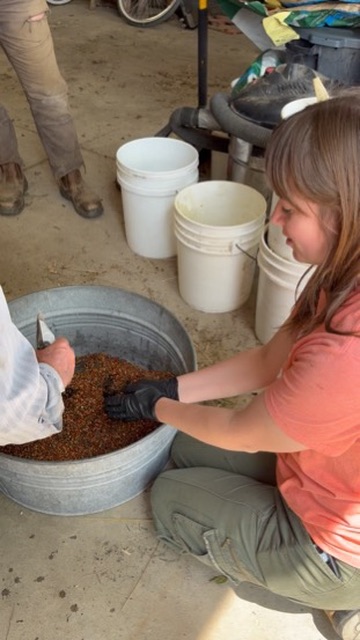
Before planting, our team mixed the sunflower seed with the companion crops that will grow alongside it throughout the summer.
Using our seed drill, we planted the field in neat 7½-inch rows, carefully placing each seed where it has the best chance to thrive.
But we weren’t planting just sunflowers.
Mixed in with the sunflower seed are cowpeas and sunn hemp, two warm-season cover crops that keep improving the soil while the sunflowers grow. They replenish nitrogen, shade the ground, suppress weeds, and help the soil hold onto moisture during the hottest days of summer.
It’s a great example of how farming often works with nature instead of against it. By planting crops that support one another, we can build healthier soil while giving our sunflowers the best possible start.
Sometimes the most important plants in the field aren’t the ones that steal the show.
Curious how it all comes together? Here’s a look at planting day in action.
Not Everyone’s Invited to the Sunflower Party
As excited as we are to see those first tiny sunflower sprouts emerge, we’re not the only ones looking forward to them.
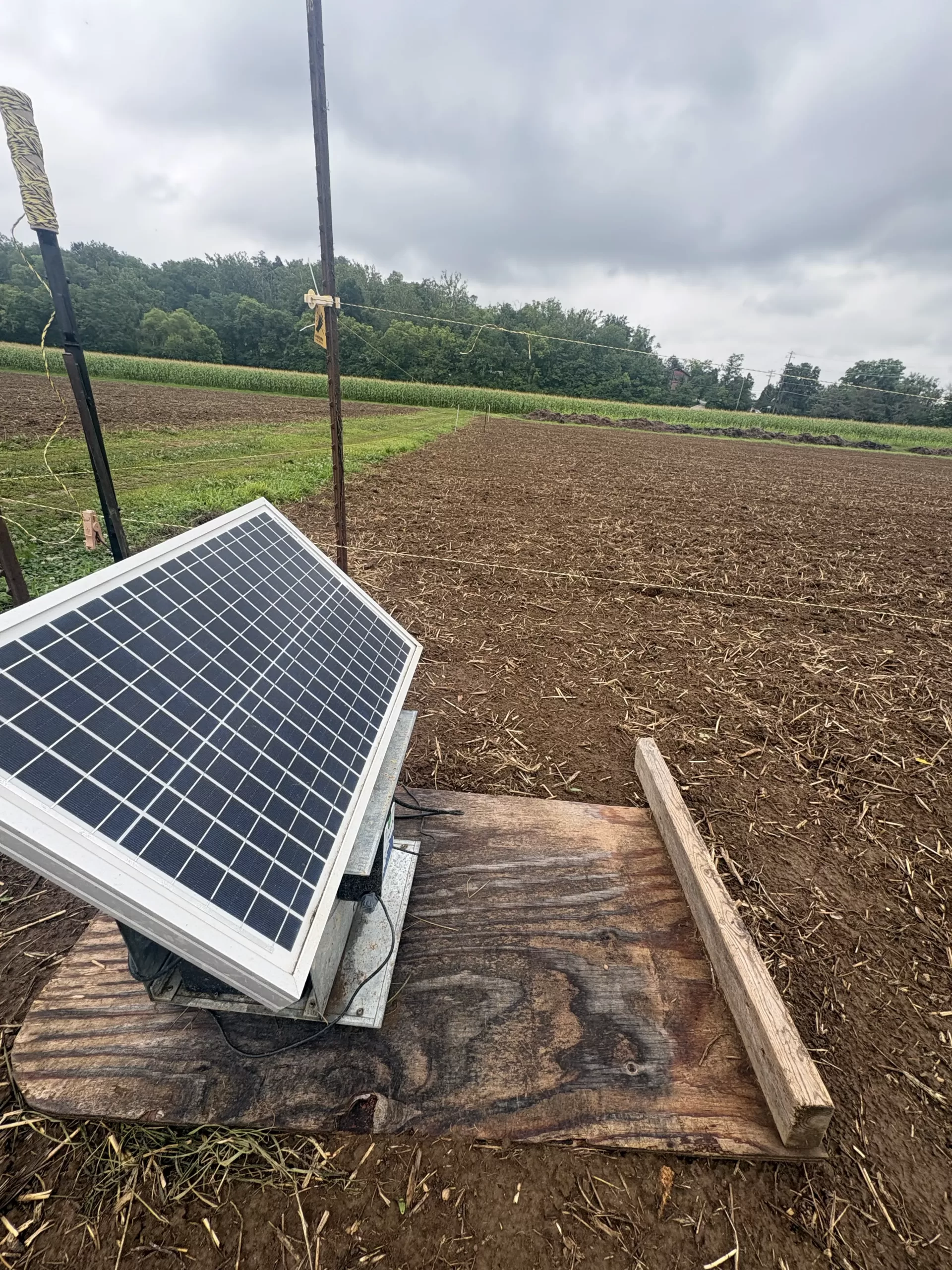
Deer absolutely love young sunflower seedlings. Without protection, a hungry herd could wipe out an entire planting in just a night or two.
That’s why we installed an electric fence around the field. It gives curious noses a quick, harmless reminder that our sunflower buffet is officially closed!
Don’t Put All Your Seeds in One Basket
One of the questions we get asked every year is, “How do you know exactly when the sunflowers will bloom?”
The short answer?
We don’t.
We can make our best estimate, but Mother Nature always gets the final say.
Under ideal conditions, sunflowers bloom about 65 days after planting, but heat, rain, and cooler weather can all change the timeline.
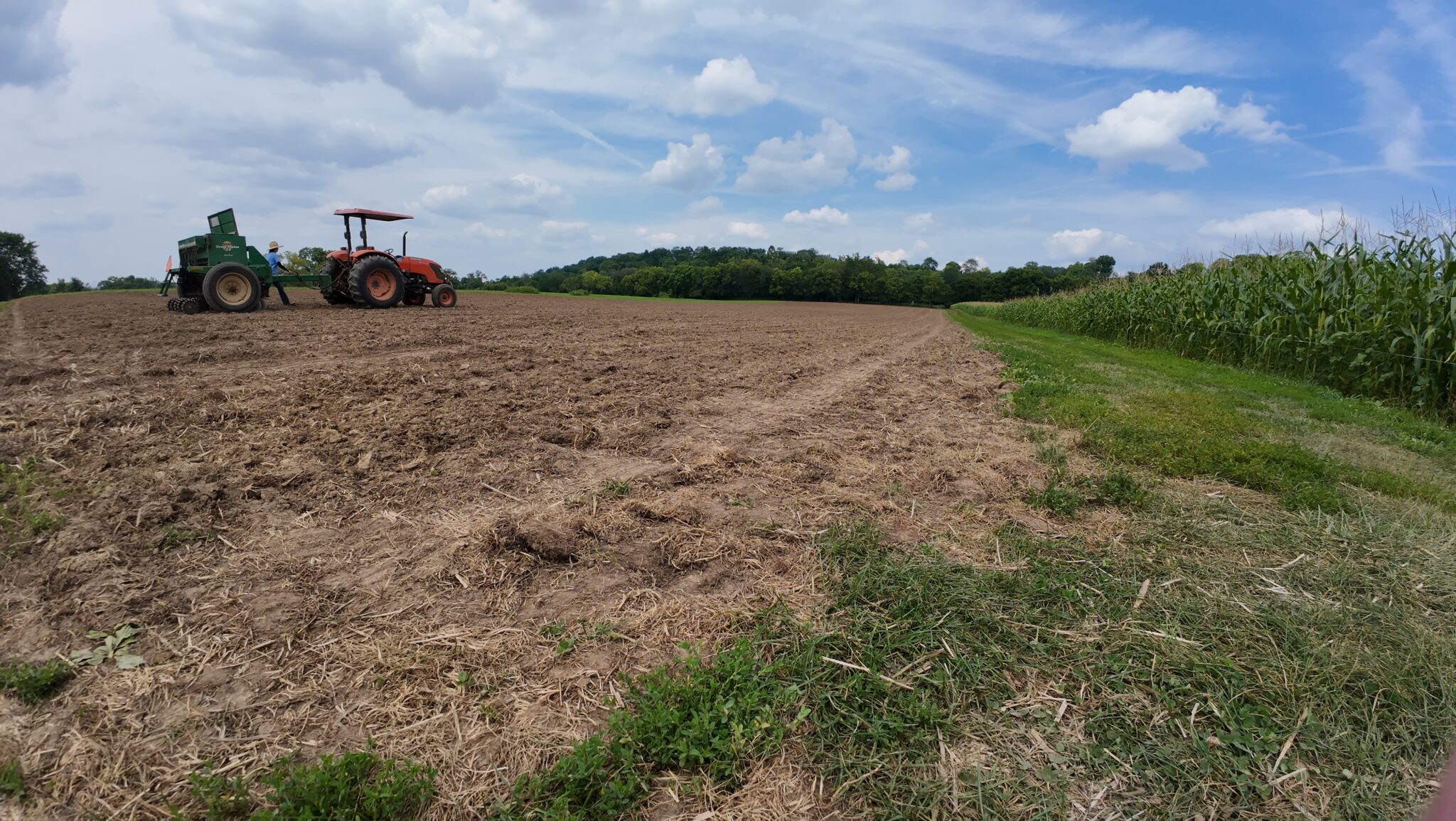
To give ourselves the best chance of having beautiful blooms for the festival, we usually do two or three staggered plantings throughout the summer. If one planting blooms a little early or late, the others help fill in the gap.
One of this year’s staggered plantings taking shape.
Follow Along All Season
This is just the beginning.
Over the coming weeks, we’ll bring you behind the scenes as the first sprouts emerge, the plants race toward the sky, pollinators arrive, flower buds begin to form, and finally the field bursts into bloom.
By the time the Sunflower Festival arrives this fall, we hope you’ll see more than just beautiful blooms. You’ll know the story behind every flower you see.
Thanks for joining us on this journey from Seed to Seed. We’ll see you in the next Bloom Bulletin!
Want to See It All in Action?
Reading about the process is one thing. Seeing it happen is even better!
Join our crop expert, Amanda, as she takes you behind the scenes of sunflower planting. She’ll show you how our seed drill works, explain why we plant the way we do, and share how all of these small steps help create the sea of sunflowers you’ll see this fall.
Watch the video below, then come back in a couple of weeks for the next edition of The Bloom Bulletin. We can’t wait to watch this field grow with you!
Every sunflower has a story. This is only chapter one.
Tiny Plants, Big Plans.
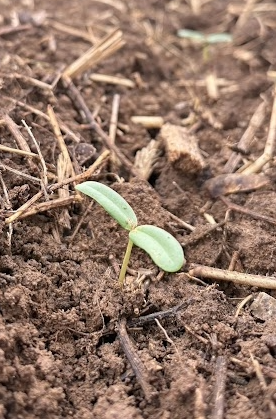
A few weeks ago, this field was mostly bare soil with thousands of seeds tucked underneath. Now, tiny green plants are popping up everywhere, and while they may not look particularly impressive just yet, this is one of the most important stages of their entire journey.
Because right now, the sunflowers aren’t just growing up.
They’re also growing down.
The Root of It All?
Before a sunflower can become several feet tall, it needs something strong enough to support everything. That work begins almost immediately.
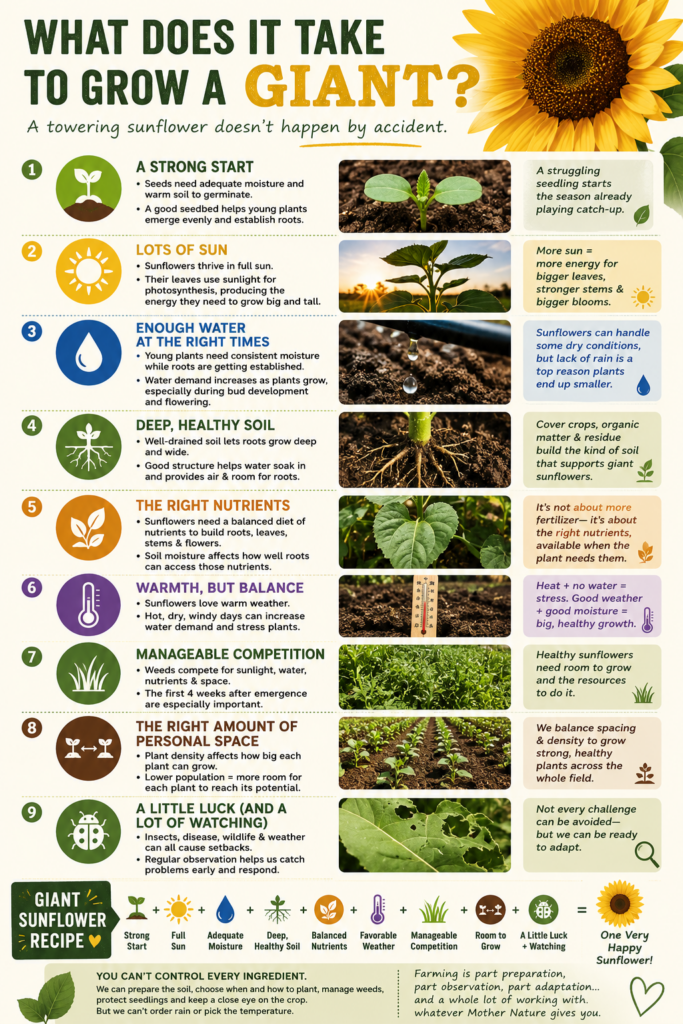
Once a sunflower seed has enough moisture and the right conditions to germinate, its first root emerges and begins growing down into the soil. As the plant develops, it builds a taproot with branching lateral roots that help anchor the plant while reaching for the water and nutrients it needs to grow.
Meanwhile, there’s plenty happening above ground, too.
Those first smooth, simple leaves on a newly emerged sunflower are its cotyledons, or seed leaves. Soon after, the plant begins producing its first true leaves, and suddenly that little sprout starts looking a whole lot more like a sunflower.
It may only be a few inches tall right now, but everything we hope to see in October starts here.
We spent months preparing this soil, and now the sunflowers are starting to use it. All that work wasn’t just good in theory. The giant sunflower above ground depends on what’s happening below it.
And right now, these little plants have a LOT of growing to do. Their roots are still developing, their leaves are still small, and they have plenty of neighbors competing for the same resources.
Some Were Invited. Some Invited Themselves.
Take a close look at the field right now and you’ll notice something pretty quickly:
Those aren’t all sunflowers.
Some of that is completely intentional! When planting, we mixed our sunflower seed with cowpeas and sunn hemp, two companion crops growing right alongside the sunflowers as part of our larger effort to care for the soil.
And then there are the plants we didn’t plant. Weeds!
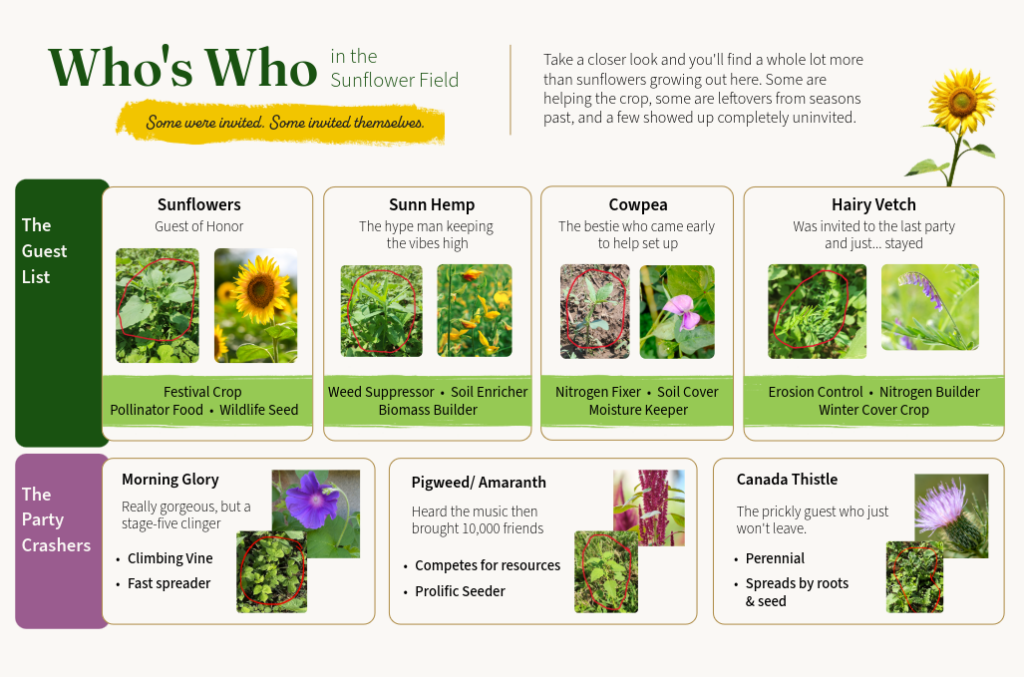
Our goal isn’t to create a perfectly weed-free field by reaching for chemical herbicides. While Gorman Heritage Farm is not a certified organic farm, we work to use organic, sustainable, and environmentally responsible growing practices whenever possible.
That means our fields can sometimes look a little messier than you might see with more conventional farming methods. But weeds still present a real challenge, especially when our sunflowers are small. They’re competing for exactly the same things: water, sunlight, nutrients, & space.
Speaking of Things We Didn’t Plant…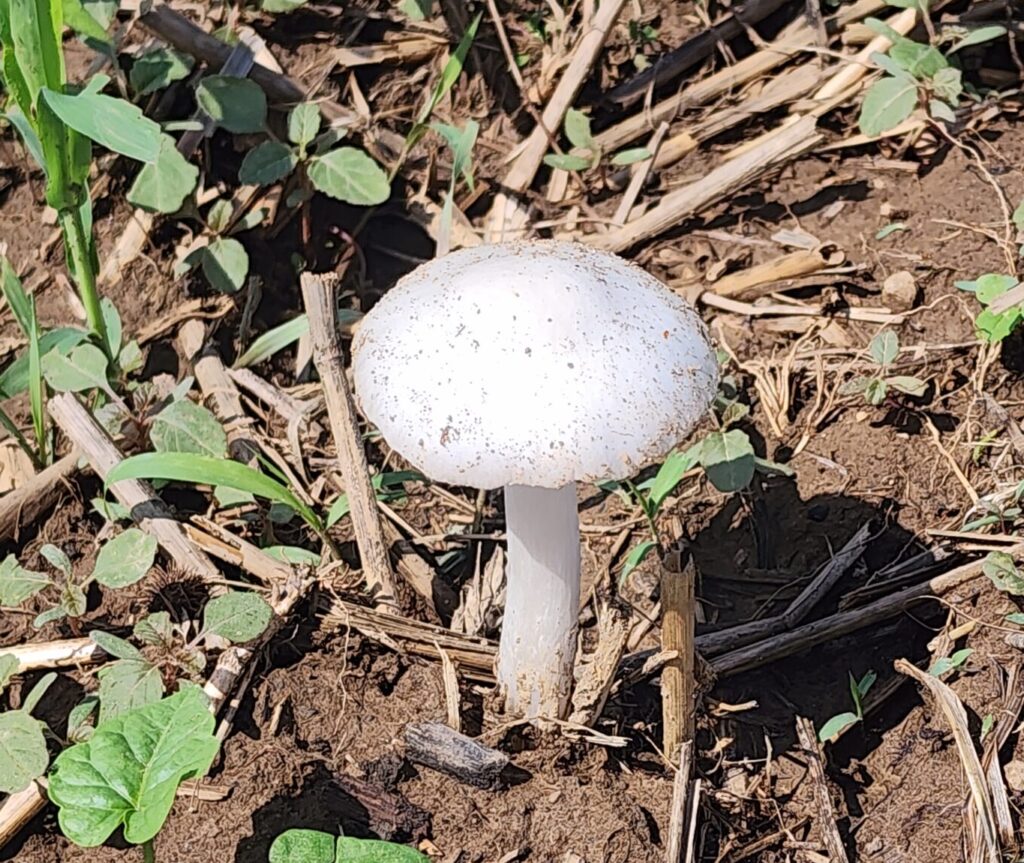
Apparently the sunflowers weren’t the only things having a good week.
While walking the field, we spotted these, too:
Exactly what kind of mushroom is it? We’re not sure! Proper mushroom identification depends on several different characteristics, many of which we can’t see from a photograph. But what’s happening beneath the surface may actually be more interesting than its name.
Because the mushroom we see above ground is only one part of the fungus.
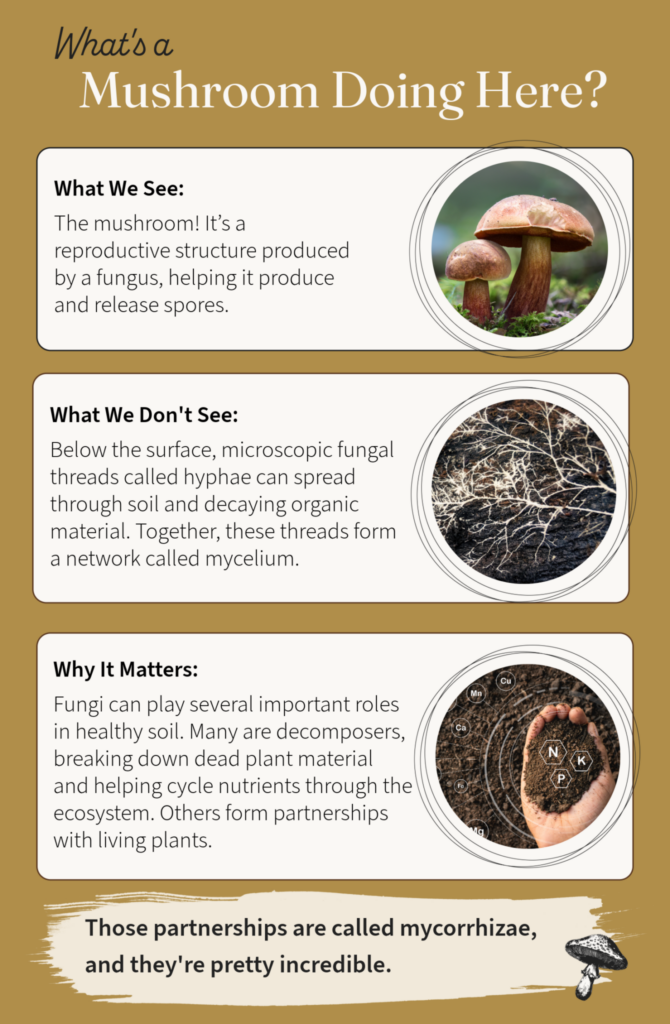 Mycorrhizal fungi connect with plant roots and extend their network of hyphae far beyond the roots themselves. Those tiny fungal threads can help plants access water and nutrients from the soil. In exchange, the plant shares sugars produced through photosynthesis with the fungus.
It’s essentially an underground trade agreement: the plant provides energy, and the fungus helps the plant access resources.
And when you’re farming without relying on synthetic fertilizers, supporting that living soil ecosystem becomes especially important.
That’s another reason we’re thoughtful about how much we disturb our soil. Intensive tillage can disrupt fungal networks, and some pesticides can negatively affect beneficial soil fungi. By minimizing those disturbances and focusing on building healthy soil, we’re helping protect the underground community our crops depend on.
All those old stems and pieces of plant material scattered across the ground don’t simply disappear. They’re part of a much bigger cycle of decomposition, nutrient movement, roots, fungi, microorganisms, and new growth.
So while we’ve been staring at tiny green sunflower leaves above ground, there’s an entirely different world at work underneath our feet.
Who’s Been Nibbling?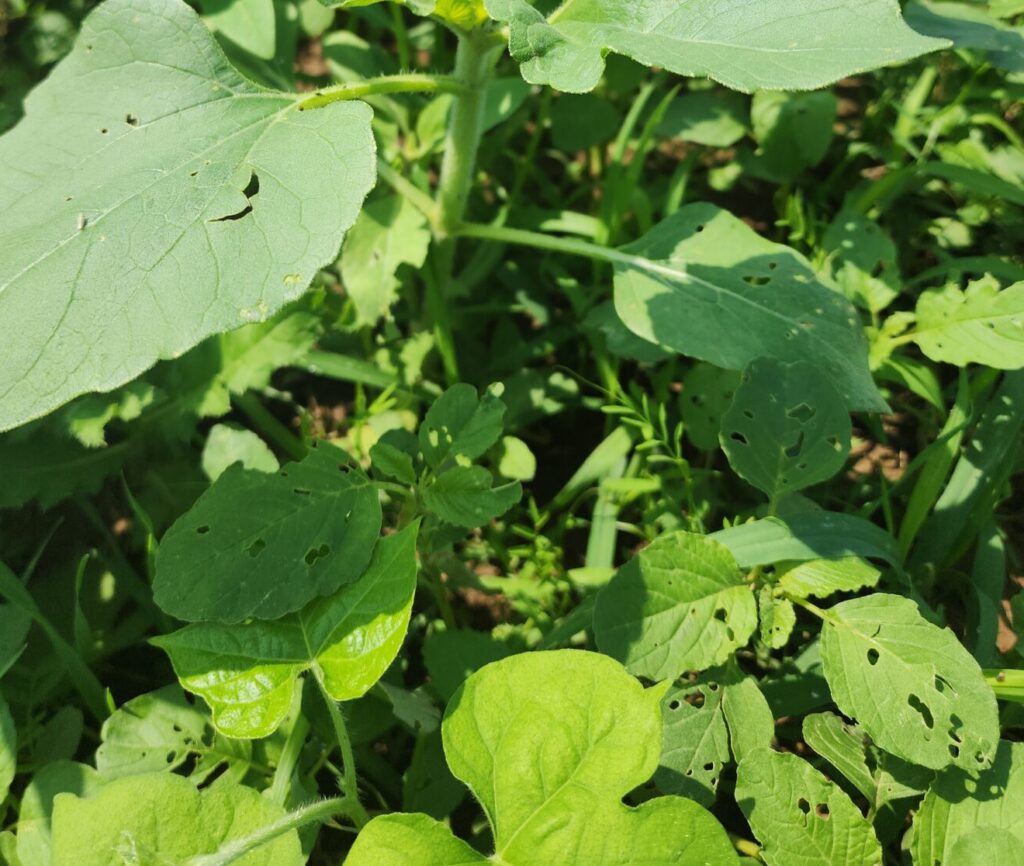
And the weeds aren’t the only visitors.
Look closely at some of our sunflower leaves and you’ll find little holes, missing edges, and a few leaves that definitely aren’t going to win any beauty contests.
Something has been snacking… But a few holes in a leaf don’t necessarily mean a plant is in trouble!
One of the realities of growing crops with an ecological mindset is accepting that a farm field isn’t separate from nature. It’s part of it.
Insects eat plants. Other insects eat those insects. Birds forage through the vegetation. Fungi and microorganisms break down dead material. All of those relationships are happening alongside the crop we’re trying to grow.
So a few imperfect leaves aren’t automatically a problem. What matters is what those leaves can tell us.
Is the plant still growing vigorously? Is the damage minor? Is it getting worse? Is something happening that could actually threaten the crop?
That’s where observation becomes one of a farmer’s most important tools.
A Healthy Field Doesn’t Have to Be a Perfect Field
And that’s really what this stage of the sunflower field is showing us.
There are weeds; there are bugs nibbling leaves; there are mushrooms; there are dozens of plants and organisms sharing the same patch of ground.
It isn’t perfectly manicured. It’s alive.
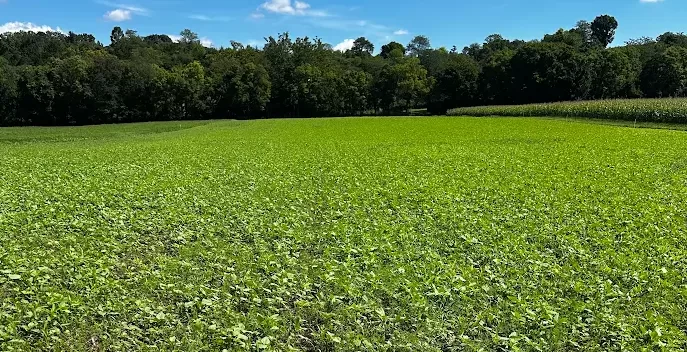
Our goal is to grow a beautiful field of sunflowers while also caring for the soil beneath them and the larger ecosystem around them. Choosing sustainable growing practices sometimes means accepting a little imperfection instead of trying to control every living thing in the field.
A healthy agricultural ecosystem doesn’t necessarily look spotless.
Sometimes it looks a little wild.
And honestly?
We think that’s pretty beautiful, too.
This Is Just the Beginning
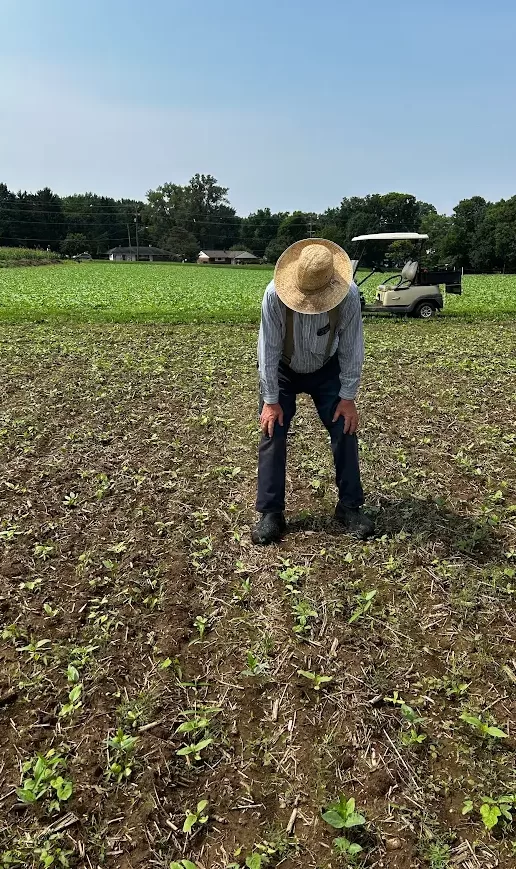
Right now, you have to crouch down to really appreciate what’s happening out here.
That won’t be true for long.
Over the next several weeks, these little plants are going to start putting on some serious growth. Their stems will thicken and their leaves will get larger. Their root systems will continue expanding through the soil in search of water and nutrients.
Before long, we’ll stop measuring our sunflowers in inches and start measuring them in feet.
For now, we’re watching the weather, checking the plants, seeing what’s growing alongside them, looking for signs of trouble, and doing what farmers spend an astonishing amount of time doing:
Staring at plants and waiting to see what Mother Nature does next.
The sunflowers are up and WE HAVE LIFTOFF!