

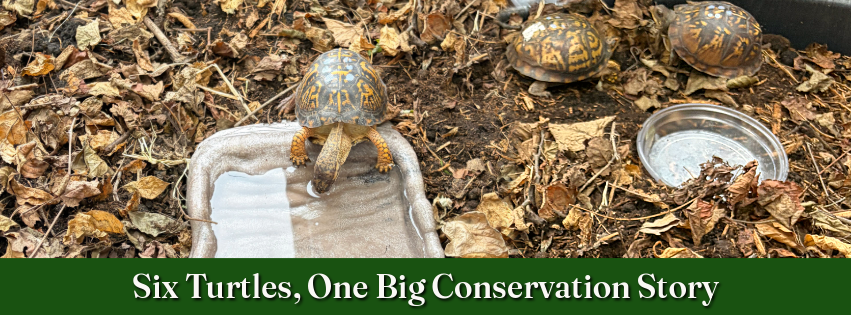
If you wandered behind the scenes at Gorman Heritage Farm today, you might be surprised to discover six quiet new residents.
You won’t find them in one of our pastures or barns. For now, they’re being cared for in a quiet, protected space at our Soil & Stars Education Center, where they can receive the specialized husbandry and monitoring they need.
They’re six adult Eastern Box Turtles.
So how did six turtles end up living behind the scenes at a farm?
It starts with a partnership—or two.
One is a statewide conservation initiative led by the Ohio Department of Natural Resources. The other is a collaboration between Gorman Heritage Farm and our educational partner, DinoBuddies, that’s bringing that work to life right here on the farm.
These six little turtles have quite a journey ahead of them, and you can be part of it! Your support helps DinoBuddies provide the food, supplies, and day-to-day care they need while supporting the bigger goal: giving these turtles the best possible chance to return to the wild.
Shell Out Some SupportHow a New Partnership is Helping Ohio’s Eastern Box Turtles
A Statewide Effort
These six turtles arrived at Gorman Heritage Farm through the Ohio Department of Natural Resources (ODNR) ROBOTS Initiative.
ROBOTS, which stands for Repatriating Ohio’s BOx TurtleS, is a statewide conservation initiative led by the Ohio Division of Wildlife that brings together partners working to support the rehabilitation, monitoring, research, and conservation of Ohio-native Eastern Box Turtles.
Like any successful conservation effort, ROBOTS relies on many partners. Across Ohio, organizations such as the Cincinnati Zoo & Botanical Garden, Cincinnati Nature Center, and others each contribute their own expertise. Here at Gorman Heritage Farm, that work takes shape through our partnership with DinoBuddies, a wildlife education and conservation organization that believes protecting wildlife begins with understanding it. Through professional animal care, scientific research, and hands-on learning, they’re helping inspire the next generation of conservationists.
Why Restoration Is Needed
Long before the first turtle arrived at Gorman, DinoBuddies had already spent months building the program from the ground up.
Before the first turtle ever settled into its new home, temporary habitats had to be built, daily care routines developed, and everything from feeding plans to sanitation procedures, biosecurity protocols, health records, and monitoring systems carefully put into place.
And that was only the beginning.
DinoBuddies directly funded the initial care infrastructure and resources needed to launch the project, while also coordinating fundraising to support its continued growth. They organized staffing and project responsibilities alongside Gorman’s team, developed internship and research opportunities, built the educational framework, and continued working with ODNR, Gorman staff, and other knowledgeable professionals as the program grows and evolves.
But there was one piece they couldn’t build on their own.
They needed the right place.
And that’s where Gorman Heritage Farm has the opportunity to provide something really unique: protected habitat where conservation, education, and research can happen side by side.
Our woodlands, meadows, and natural areas aren’t just beautiful places to explore. They’re exactly the kind of habitat Eastern Box Turtles need to thrive. They also create opportunities for our staff to collaborate on animal care, conservation planning, educational programming, and long-term stewardship. By serving as a release and monitoring site, the farm will also contribute valuable data that helps researchers better understand successful turtle reintroductions and guides future conservation efforts.
Together, these partnerships are creating much more than a temporary home for a few box turtles. We’re creating a living conservation program where wildlife care, scientific research, education, and habitat stewardship all come together in one place.
Meet the Eastern Box Turtle
The six turtles currently making their temporary home here at Gorman Heritage Farm, under the care of DinoBuddies, are all Eastern Box Turtles, one of Ohio’s most remarkable native reptiles.
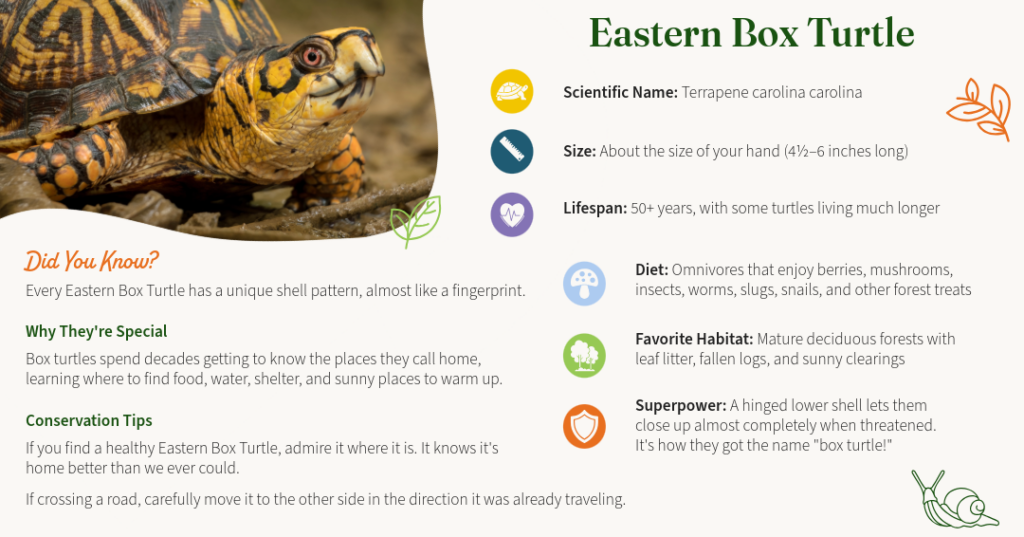
Have you ever spotted one in the wild? Maybe it was slowly making its way across a woodland trail or tucked quietly beneath a patch of leaves. These beautiful turtles are easy to recognize by their colorful, domed shells decorated with yellow and orange patterns. In fact, no two turtles are exactly alike.
You may have also noticed that unlike a deer, chipmunk or other critter you may encounter on your hike, these friends are much less likely to scurry and run from danger. Instead, they simply stop, pull their head and legs inside their shell, and wait for danger to pass. It’s a quiet reminder that sometimes the best defense isn’t speed, but patience.
That slow-and-steady lifestyle isn’t laziness. It’s survival.
What many people don’t realize is that Eastern Box Turtles become deeply connected to the places they call home. Over time, they learn where to find food, where the best sunny spots are after a cool morning, and where to safely shelter through the changing seasons. Every log, patch of berries, and quiet hiding place becomes part of a landscape they know by heart.
That’s why helping a box turtle isn’t always as simple as moving it somewhere else. Conservation takes careful planning, healthy habitat, and an understanding of both the turtles in our care and the wild turtles already living on the landscape.
The six turtles currently living at Gorman are helping us learn exactly how to do that.
Why This Initiative Matters
Eastern Box Turtles have quietly called Ohio’s forests home for thousands of years. Today, however, they face more challenges than ever before.
Habitat loss, roads, and illegal collection for the pet trade have all contributed to declining populations across Ohio. The Ohio Division of Wildlife cares for native box turtles that have been confiscated after being illegally kept as pets. While many of these turtles can be successfully rehabilitated, returning them to the wild is much more complicated than simply opening a carrier and letting them go.
Releasing turtles responsibly requires careful planning. Conservationists need protected habitat, healthy ecosystems, and long-term monitoring to understand how the turtles adapt after release. Every approved release site helps expand the program and increases the number of turtles that can safely return to the wild while contributing valuable information for future conservation efforts.
We’re honored to have the opportunity to become one of those sites.
More Than Turtle Care
The work happening at Gorman Heritage Farm extends well beyond caring for the six turtles living at Soil & Stars.
Together, DinoBuddies and Gorman Heritage Farm are also learning about the wild Eastern Box Turtles that already call the farm home.
When a wild turtle is found on the property, trained team members can safely collect quick, non-invasive saliva and fecal samples to help monitor the health of the local population. Every turtle is carefully documented before being returned to the exact place it was found, facing the same direction it was traveling.
To make sure the same turtle isn’t sampled twice, a small, non-toxic, washable paint mark is temporarily placed on its shell. It’s a simple system that helps keep the monitoring process organized while leaving no lasting impact on the animal.
The partnership is also helping train the next generation of conservationists.
Through DinoBuddies’ internship and research program, students gain hands-on experience in wildlife husbandry, conservation, and scientific observation while studying the natural foods available throughout Gorman Heritage Farm. From seasonal berries and native plants to worms, insects, snails, slugs, and other invertebrates, interns are helping build a better understanding of how Eastern Box Turtles naturally use the landscape throughout the year.
Behind Every Turtle is a Story
Before turtles are released, conservationists first learn about the turtles already living at the farm.
- Saliva and fecal samples help monitor the health of the local population.
- Every turtle is returned to the exact spot where it was found, facing the same direction it was traveling.
- A small, washable paint mark lets our researchers know that turtle has already been sampled.
- The information collected helps protect both resident turtles and future releases.”
Conservation Takes a Team… and a Turtle
Conservation isn’t a solo project. It takes people who care, places willing to help, and sometimes a very patient turtle to remind us why the work matters.
This project is possible because every partner brings something unique to the table.
ODNR provides statewide leadership through the ROBOTS Initiative. DinoBuddies leads the conservation program at Gorman by coordinating project management, animal husbandry, fundraising, research, internships, volunteer engagement, public outreach, and continued collaboration with ODNR, Gorman staff, and other knowledgeable professionals as the project evolves.
Gorman Heritage Farm provides the habitat, facilities, conservation-minded staff, and educational opportunities that allow this work to happen. Together, we’re creating opportunities for our community to experience conservation not as something happening somewhere else, but as something growing right here in our own backyard.
Whether it’s through educational programs, volunteer opportunities, research, or simply learning the story of six remarkable turtles, we hope this project inspires more people to notice, appreciate, and protect the incredible wildlife that shares our home.
Looking Ahead
Our six little trailblazers currently living at Gorman Heritage Farm are only the beginning.
In the months ahead, we’ll continue sharing updates from behind the scenes, introducing you to the turtles in our care, highlighting the research happening across the farm, and following this partnership as it continues to grow.
Because every healthy habitat starts with people willing to care.
Every successful conservation effort starts with collaboration.
And sometimes…
It starts with six little turtles.
Coming Soon